
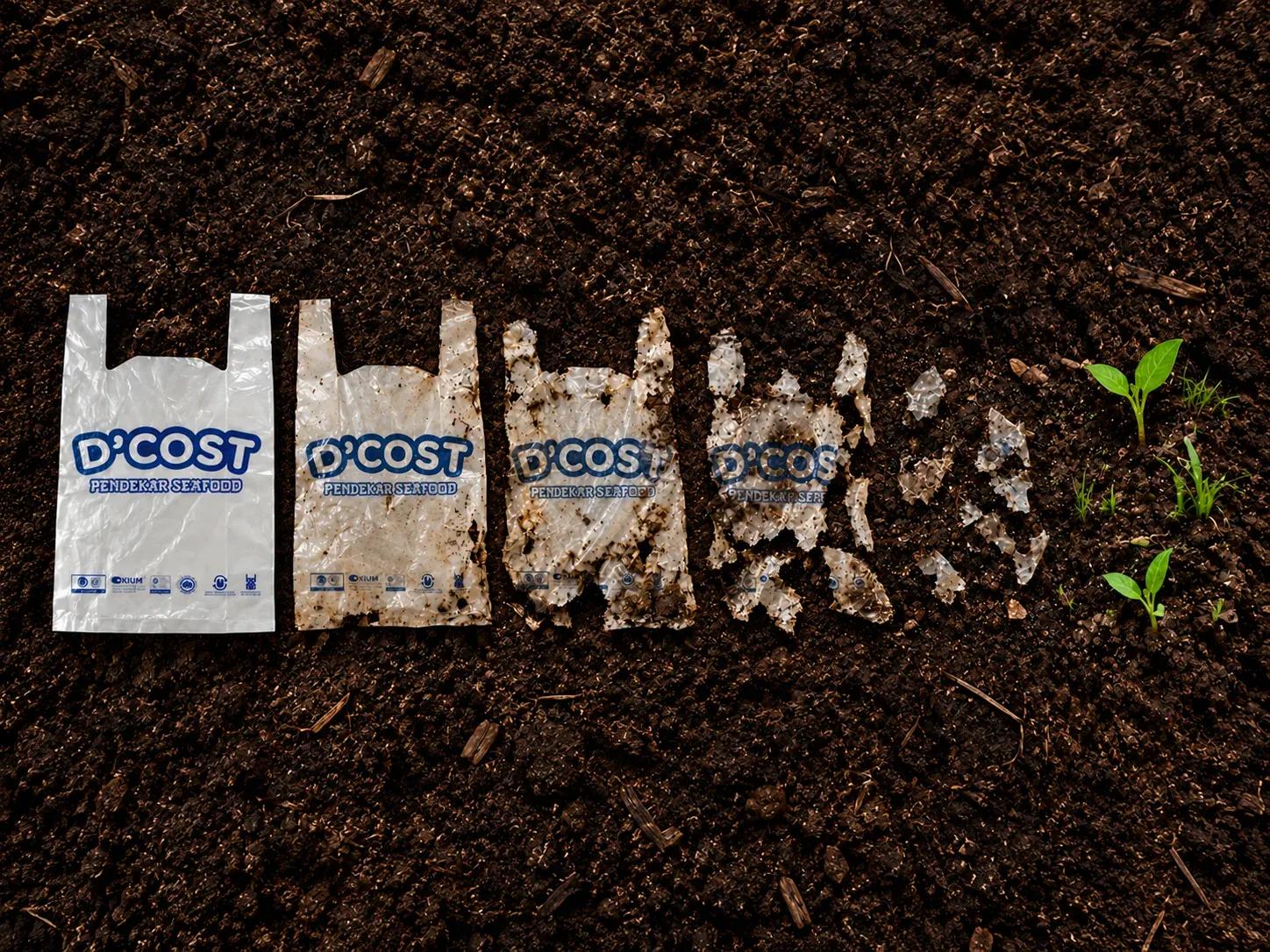
What is biodegradation?
Plastic that breaks into smaller pieces has not gone anywhere. Biodegradation is the point at which a material stops being plastic at all, when microorganisms metabolise it into carbon dioxide, water and biomass. Every technology we make is built to reach that point, and to be measured on whether it does.
One problem, three price points
Two questions decide what a plastic is and what becomes of it. Where does the carbon come from, fossil or plant? And what happens at end of life, does it biodegrade or not?
Plot those as two axes, and almost everything in use today sits in the same corner: fossil-based and non-biodegradable. PVC, PC, PS, PE, PP, PA, PET. Moving material out of that corner is the entire task.
Oxium
Biodegradable additive
Fossil-based, biodegradable. For multilayer packaging and mid-to-low film markets. Oxium changes the end of life of material that would otherwise persist, the material fully biodegrades within approximately 2–5 years.
Ecoplas
Starch-based grafted bioplastic
Bio-based, biodegradable. For rigid packaging and mid-segment product lines. Cassava starch, grafted into the resin, a process designed to make the material more susceptible to microbial activity. Biodegrades within approximately 1–2 years.
Naturloop
Plant-based grafted compostable bioplastic
Plant-based, compostable. Cassava starch, grafted with compostable polymers built for one purpose: to break down completely. Naturloop biodegrades within approximately 6–9 months, depending on grade and environment.
Fragmentation, degradation, biodegradation
Most of the confusion around “eco-friendly plastic” comes from three words being used as though they mean the same thing. They do not, and the difference between them is the difference between a solution and a slower version of the problem.
- 01
Fragmentation
The material breaks into progressively smaller pieces. Size alone changes nothing, a fragment can carry the same molecular weight as the item it came from. This is the stage where conventional plastic stops.
- 02
Degradation
The material loses its physical properties. It becomes brittle, weak, discoloured. The polymer chain begins to break and to take on oxygen.
- 03
Biodegradation
The chains are now short enough, and oxidised enough, for microorganisms to metabolise them into CO₂, water and biomass. The carbon re-enters the natural cycle.
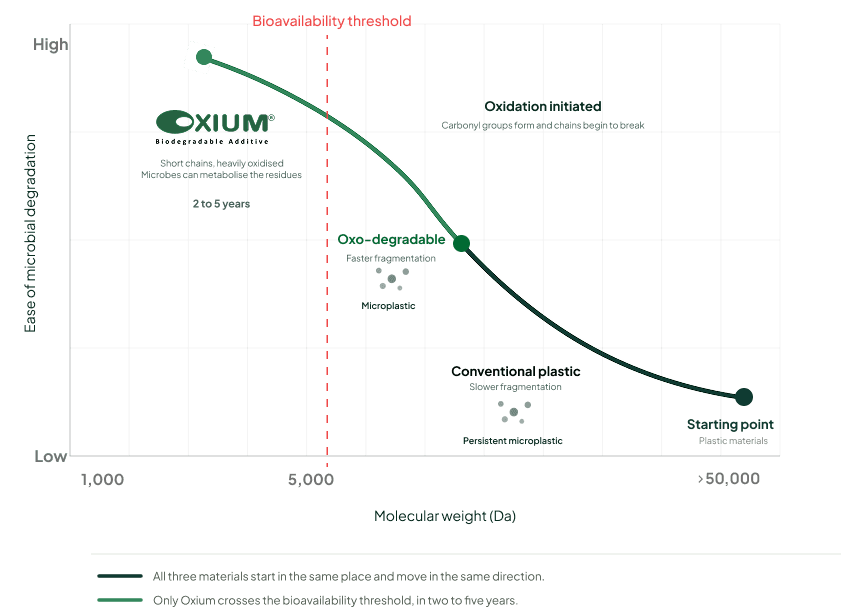
Biodegradation only begins when three things are true at once. The chains have to be short enough to be eaten, below roughly 5,000 Daltons rather than the 250,000 of conventional polyethylene. They have to be oxidised enough for a microbe's enzymes to recognise them as food. And the right microorganisms have to be present, which is why a single biodegradation figure means nothing without naming the environment.
Oxium is not
oxo-degradable plastic
The two are routinely confused, and the confusion matters, because one of them is the reason degradable plastic has a bad name. Both begin in the same place: a long, unoxidised polymer chain. What separates them is what happens next.
| Oxo-degradable plastic | Oxium |
|---|---|
| Particle size falls, but molecular weight falls slowly. | Molecular weight and oxidation change together, not one without the other. |
| Oxidation stays low, so the fragments remain hard for enzymes to act on. | Chains cross the bioavailability threshold in a chemically altered state. |
| The material can move in the same direction, but so slowly that in practice it persists as microplastic. | Microorganisms consume the fragments within two to five years in landfill and soil. |
Same pathway. OXIUM takes the process further toward lower-molecular-weight residues and greater microbial accessibility.
Biodegradation you can watch
The Greenhope Bioplastic Living Lab is a real-life representation of how our products biodegrade. Products are placed in terrariums that replicate natural environments and monitored until biodegradation occurs. Each terrarium is divided into two sections: conventional plastic on one side, Ecoplas, Naturloop or Oxium on the other.
| Oxium | Ecoplas | Naturloop |
|---|---|---|
| Biodegrades in landfill within 2 to 5 years | Biodegrades in soil within 1 to 2 years | Composts within 6–9 months |
| Consumed by microbes, does not damage soil condition | Does not damage soil condition | Composts both industrially and at home |
| Does not produce microplastic | Does not produce microplastic | Does not produce microplastic |
Oxium and microalgae
Almost everything that lives in water depends on microalgae for food. If plastic harms them, the harm travels up from there. Two tanks, same water, different plastic.
The standards we measure against
Each of our technologies is tested against the standard written for its category, and each standard tests a different thing.
| Oxium | Ecoplas | Naturloop | |
|---|---|---|---|
| Category | Biodegradable additive | Starch-based bioplastic | Compostable bioplastic |
| Form | Additive, 2–10% into conventional resin | Cassava starch, grafted with synthetic polymer resin | Plant-based starch grafted with compostable polymer resin |
| Time to biodegrade | 2–5 years | 1–2 years | 6–9 months |
| Environments tested | Landfill | Soil, landfill | Soil, home compost, industrial compost |
| Degradation protocol | ASTM D6954, Tiers 1–3 | ASTM D5988 | ASTM D6400 · ASTM D5338 · ASTM D5988 · ISO 20200 · ISO 14855 · EN 13432 |
| Biobased content | Not applicable, fossil substrate | ASTM D6866 (DIN CERTCO) | ASTM D6866 |
| Safety & compliance | BPOM · FDA · Halal | BPOM · Halal · Food grade | Food grade |
| Production emissions | Not applicable | 30% lower GHG · 45% less energy | 30% lower GHG · 45% less energy |
ASTM D6954 is a three-tier framework rather than a single pass mark. Tier 1 measures abiotic degradation, Tier 2 measures biodegradation, Tier 3 measures ecological impact. A technology that reports only Tier 1 has demonstrated that its material falls apart. We report all three, because only Tiers 2 and 3 speak to the question people actually want answered.
What independent researchers found
Four peer-reviewed studies from Indonesian and international research groups have tested it directly.


Ask us for the data
If you are evaluating a material for a product line, our technical team will send the full test reports, the standards documentation and the study PDFs, and answer the questions this page did not.